Home / Blog / Q4 Freelancer Pitch Kit: Proposal Pages and a Rate Card You Can Print
Q4 Freelancer Pitch Kit: Proposal Pages and a Rate Card You Can Print
October through December is when many freelancers scramble for next-quarter work—or quietly fill the calendar before everyone disappears into holidays. Either way, pitching gets louder. Your proposals should stay calm.
A clear printed proposal and a one-page rate card will not close every deal. They will stop you from improvising scope on a Zoom call with a half-finished Google Doc open behind you.
This guide is for freelancers who like paper: letter-size pages, ink notes in the margin, a folder you can hand across a table or scan as a PDF.
Why Q4 pitches need more structure
Budget conversations tighten at year-end. Clients compare options. They ask for “a quick number” that somehow becomes the whole engagement. A written proposal forces the conversation onto deliverables, timeline, and price—before you start unpaid discovery forever.
A separate rate card helps when someone wants à la carte clarity: hourly ranges, package tiers, or add-on fees. You can attach it, leave it on the table, or reuse it all season without rewriting the essay portion of every pitch.
Anatomy of a proposal that fits on paper
Keep it short enough to print without shame. Five to eight pages is plenty for most solo engagements. Longer only if the client asked for a deck.
Cover / title
Project name, your name, date, and their company. Quiet typography. No stock photos of handshakes.
Problem and goal
Two short paragraphs. What they want to change, and what “done” looks like in their words. If you cannot write this from the discovery call, you are not ready to price.
Scope
Bulleted deliverables. Explicit out-of-scope items. Revision rounds. Dependencies on their side (assets, approvals, access).
Timeline
Milestones with dates or week ranges. Note holiday blackout weeks in November and December so no one is surprised.
Investment
Price, payment schedule, and what triggers the start (deposit, signed page, PO). If you offer options (lean / standard / expanded), put them on one comparison page so the choice is visual.
Next step
One sentence: how they accept, and what you need within X days to hold the start date.
Building a rate card that stays useful
A rate card is not a manifesto. It is a reference sheet.
Include:
- How you sell — hourly, day rate, or packages
- What is included at each level
- Common add-ons — rush fees, extra rounds, travel, licensing
- Minimums — project floor or retainer floor, if you have one
- Validity — “rates current as of [month/year]” so Q1 you can refresh without confusion
Leave a margin for handwritten notes during a meeting (“their budget ~X,” “prefer monthly”). Ink on a printed card is often more honest than editing a live document under pressure.
A Q4 pitching rhythm
- List warm leads — past clients, referrals, stalled summer conversations.
- Refresh the rate card once for the season. Print a small stack.
- Draft proposals from a template, not from scratch each time. Swap problem, scope, and price; keep layout identical so your brain stays on content.
- Send PDF + offer a print walkthrough for local or high-touch clients.
- Log every send (date, contact, version) on a single sheet so follow-ups are not guesswork. An invoice log printable is a natural desk companion if you add one later; for now a lined page works.
Mistakes that blur good pitches
- Pricing in the email body and never repeating it in the proposal
- “Flexible scope” with no out-of-scope list
- Rate cards that list twenty services you no longer offer
- Sending three revised PDFs without a version date in the footer
Stationery habits fix most of these: one master template, dated pages, a physical folder per opportunity until it converts or dies.
Ready-made proposal and rate card pages
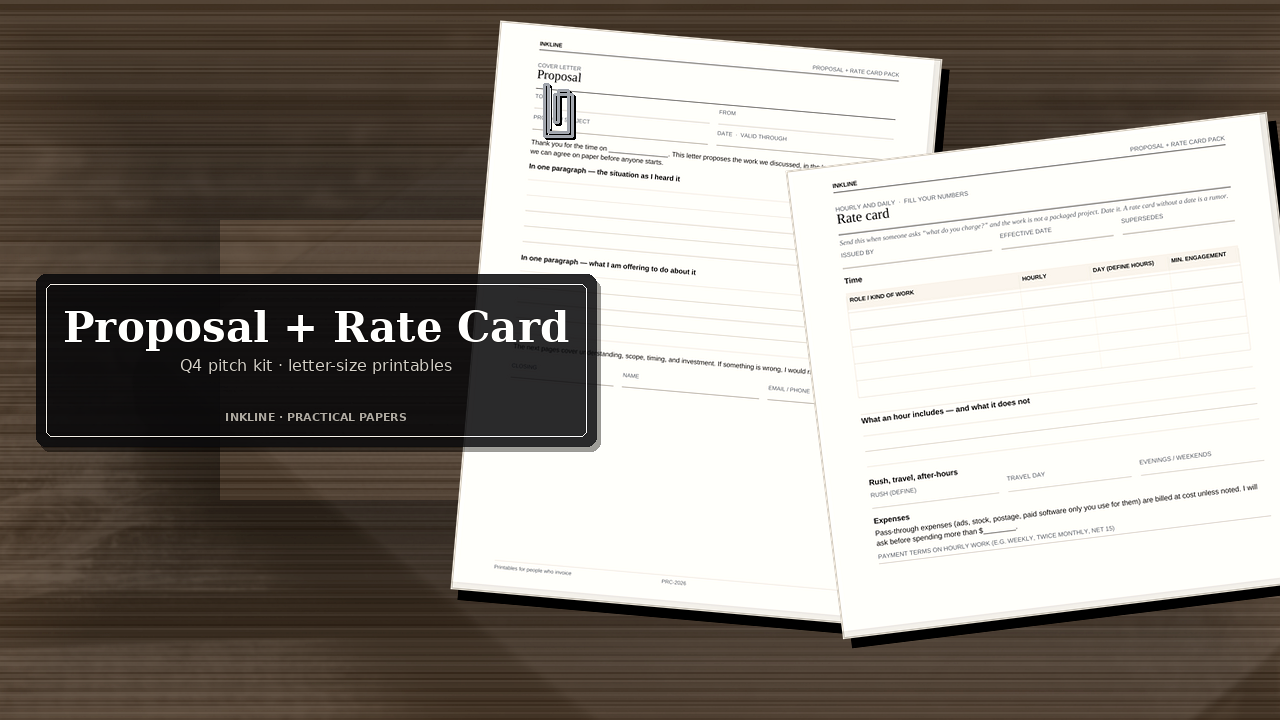
If you want letter-size proposal and rate-card layouts already designed for freelancers—clean, print-first, no software lock-in—see Inkline’s Proposal + Rate Card Pack. Fill, print, or export to PDF; keep the voice yours.
When a pitch becomes a client, pair it with a calm onboarding stack from the Client Binder Kit so the handoff from “yes” to kickoff stays as tidy as the proposal.
Browse all current kits at Inkline.
Soft close for the season
Q4 hustle does not require louder marketing. It requires repeatable paper: a proposal you trust, a rate card you can defend, and a follow-up note you actually write. Print the pages. Ink the numbers. Send the PDF. Then go back to the work.